Saturday, March 24, 2007

Catalyst on Water


Dr Bhamy Shenoy has mailed the following note on Catalyst magazine, an NRI initiative, that devotes its current issue to Water.

Four years ago, some residents of Chennai were leaving town due to water shortage. The Hindu, in an article 4 months ago, said Chennai had too much water now. If you open the city corporation tap, water actually comes out, instead of plain hot air four years ago.

A contributing factor in Chennai’s transformation is Rain Water Harvesting. We still (in Chennai) have a long way to go in order to ‘mainstream’ rainwater harvesting in our daily life. Other southern states have followed the lead taken by Tamil Nadu.

Water for life and water for livelihoods’ is the maxim expressed in the 2006 United Nations Development Programme’s (UNDP) Human Development Report (HDR). Water insecurity violates the basic principles of social justice. Access to water is a basic human need and fundamental human right, yet more than one billion people worldwide are denied the right to clean water. Water pervades all aspects of human development; when people do not have access to clean water their choices and freedoms are constrained by ill health, poverty and vulnerability. Thus, water gives life to everything, including human development.(“Jal hai, to kal hai” in Hindi means “If you have water, you have a tomorrow”)

Catalyst for Human Development’s latest Water issue has articles ranging from sustainable rural water management to rainwater harvesting. You can DOWNLOAD the full PDF file (5.9 Meg) at www.afhd.org . If you need printed copies, details are given in the magazine. You may contact editor at editor@afhd.org with any questions or comments

Tuesday, March 20, 2007

Scrapbook Jottings–4

JFK killing wire copy: Associated Press story sent to newspapers through teleprinter sold at a New York auction in March 1997. Seven-foot paper roll of AP story, giving a moment-to-moment account of the first 90 minutes after the JFK killing (Nov.22, 1963, at Dalles) fetched $10,000, for a disabled Vietnam veteran Donald Zammit, who had found the wire copy in an envelope after his father’s death.

Newspapermen: Most of what they do is superficial, out of balance, prejudicial when they claim impartiality, and riddled with inaccuracies. They blame inaccuracies on an obsession with speed, which is used the way a cripple uses a crutch. Being slower, checking facts before they storm into print might be better public service. They are critics, self-appointed judges of everybody’s failings except their own. (Do not know who said this, where, when and in which context.)

Friday, March 02, 2007

Peru, India and the punctuality drive

It was Ecuador in 2003. and it is Peru today that is poised to combat chronic lateness. The Latin American late-running nation has launched a punctuality drive. After hearing the news on the BBC, I wondered when, if at all, we in India would look at chronic lateness as a serious issue.

I have been flogging this message on the web ever since I read in 2004 a New Yorker piece on the campaign in Ecuador. The magazine feature - Punctuality Pays - said, "At high noon last October 1, the citizens of Ecuador did something they'd never dreamed possible, they synchronized their watches". They did four other things:

1) Ran a nationwide poster campaign to convey the message that punctuality pays

2)Public and private institutions - from local councils to major industries - took a pledge to keep time

3) Late-comers were turned away from offices and factories, with placards reading 'Don't Enter; Work Started on Time'

4) And newspapers published everyday a list of dignitaries and public officials who turned up late at public events.

Peru, emulating Ecuador, has clocked in its drive - 'Peru on Time'. At noon on March 1, President Alan Garcia sounded a bell signaling the nation's 28 million people to synchronize their watches. Peru and punctuality have been incompatible; and chronic lateness was often overlooked by Peruvians who considered it an endearing cultural trait.

How Indian, I thought. It's in fact also a very Mysorean trait.

Another similarity between the two countries: nothing in Peru - wedding reception, funeral, social dinner or a business meeting - ever starts on time. Travel guides for western tourists observe that Peruvians expect friends to be late for an appointment.

So tourist brochures advise foreign visitors, rather thoughtfully, not to arrange to meet a Peruvian on a street corner - make it a café or bar. If, for some obscure reason, you want someone in Lima to turn up on time, you will be well advised to stipulate that the meeting is a la hora inglesa (by the English time).

Peru has now officially declared that to be late would no longer be fashionable. The Forum of National Consensus, a government-led council of business and citizens' groups, which is steering the campaign has directed schools, businesses and government offices to stop tolerating 'Peruvian Time", which usually means an hour's lateness. We have such close commonality in our bad habits, Peru and India.

Peru has chosen to do something about it. When will we in India do the same? For a start, wouldn't you like to see our media and corporates sponsor a public interest message recognizing punctuality as a civic virtue that represents respect for the other person's time?
--------------------

This piece is cross-filed in Desicritics; and evoked following comments:

Karthik
I understand your concern for this cultural level change. Unfortunately going from A to B involves lot of challenges! Bus, traffic, political rallies. People get used to this and becomes a habit. Make no mistake. I am not justifying this. I am all for coming on time. But it is upto the individual to correct himself in a country like India. Nationwide changes require the concerned people to lead by example which they are never going to do. I myself am guilty of being a little late for some unimportant events. But things like interviews, meetings i am always ahead of time.

Ashish
Oh, to be late is an institutional thing in India. If you are invited for a wedding and the time says 8 PM, and you reach there at 8, you could literally help in setting the place up.
In fact, at my marriage, the whole procession reached around 30 minutes after the written time, and my bride also was not ready since no one expects the groom's party to arrive anywhere near time :-)

bharath
why is punctuality a human virtue? Its likely to help machines when they synchronize activities, communication, etc.
all those poems written about waiting, a waste? :)

BUG - The Brotherhood of Unwelcome Guests

Desicritic Uma Ranganathan's much-commented piece on an unwelcome guest, inspired me to recycle this piece that was written four years back. But I reckon it will stay valid for the next 400 years. My piece was written in a spirit that if anyone were to be shown in an unflattering light, it better be yours truly in the interest of maintaining domestic harmony. So, here it goes:

Athtiti Devo Bhava. I don't know if such a thing is really in our scriptures or it is just something made up by an inventive mind advocating the cause of the Brotherhood of Uninvited Guests (BUG). Whoever thought of it knew how our middle-class mind works. The three-word sloka is so embedded in our belief system that few of us can bring ourselves to turn away an unwelcome guest who appears unannounced at our doorsteps. You wouldn't want to drive away the Lord, would you?

Someone did just that, to me, in the US. They called the bluff on that devo bhava nonsense. Suffice it to say that those involved was a desi family well known to us. Giving away much more would not be in the interest of my domestic harmony.

It so happened that my wife and I were at loose ends on a Sunday afternoon and so our son took us for a drive. Some 40 minutes out of our home I was told we were close to where this desi family was staying. I suggested we drop in on them.

"Unannounced?" asked my son, "Without as much as a call?"

"Why not?" I thought my son, having stayed in the US for some time now, had forgotten the three words in Sanskrit that would open Indian doors even to strangers. After all, this desi family was so well known to us that they should be happy to see us any time.

My son tried to reason with me. I was firm. My wife didn't say anything, maintaining an enlightened neutrality in a disagreement between father and son.

I prevailed. And as we neared the driveway of our friend's suburban house we noticed the family of four was leaving for some place and the lady of the house was closing their front door. We stepped out of our car and met them on their driveway. They were nice and syrupy, but made no move to ask us in.

"What a surprise," said the lady of the house, "I wish you had called before coming."

I mumbled something to the effect that we had not planned this visit, but decided to drop in, on the spur of the moment. After a few more minutes of small-talk, still on the driveway, we exited as gracefully as we could.

"You must come again," said our host, "we must have a meal together." She was polite, but firm in slamming the door on us.

At our place I let my wife handle a sticky situation by letting her answer the door-bell. I do not intervene in her door-step inquiry into such unwelcome intrusion. I pretend not to hear my wife when she calls me to the door to greet an unannounced visitor. Of course, I sulk and usually take it out on her whenever we are lumbered with a visitor we could very well do without.

An unwelcome guest often gives cause for domestic discord in our otherwise peaceful married life. The snag is, my wife relishes her reputation as a gracious hostess, particularly among fair weather friends and relatives. Such is her hospitality that those who come to our place once would want to come again. I keep reminding my wife, "We are running a household, not a 'Welcomgroup' outfit."

The last 'guest' we had stayed only for a night, mercifully. We have had people coming in groups, including unmanageable children, without as much as a phone call announcing their arrival, and staying for days. Our overnight 'guest' dropped in around 8 pm, and promptly settled into the only rosewood armchair in our living room that doubles as my study. It was not yet our dinner time; it was the time my wife and I spend reading a book or magazine in companionable silence. With our evening so rudely interrupted, my wife went to the kitchen to get dinner ready, leaving me to cope with the lady in the rosewood chair.

I don't remember the details of the small talk we indulged in for the next 15 minutes. But my wife rescued us from what seemed an interminable 15 minutes by announcing dinner. To be fair to the lady, an out-of-towner, she didn't drop in on us unannounced. She gave my wife a few hours notice when they met at a common friend's place earlier in the day. The lady had told my wife she was inviting herself to our place for the night. When my wife sought to explain that things at home were in a mess the lady said, "Don't worry, I will adjust." I thought it was the host who would have adjustment problem in the circumstances.

When it was time for her to leave my wife sent her off with the traditional offering of the kumkum and an invitation to visit us again. My hunch is that the lady took my wife for her words. I don't suppose our guest had any inkling of my smoldering resentment at her for having taken us for granted. .

Cross-filed in Desicritics

Wednesday, February 28, 2007

Media self-censorship

A Deccan Herald article speaks of an unnamed company CEO’s disenchantment with IIT graduates. In reference to their poor caliber he is quoted as saying, “we are not likely to recruit them any longer”. Who are ‘we’ and who is this person speaking on their behalf? He is Mr Muthuraman, MD, Tata Steel.

Naming name in this context would have added credibility. Without the name, the story carries no thrust. And is unlikely to be taken with the seriousness the issue deserves. What’s worse, the writer of the newspaper article, Bhamy V Shenoy, exposes himself to the charge of dressing up his prejudice (against IITs) by inventing a quote by conveniently unnamed sources.

Dr Shenoy says he named the company and its MD; it was the newspaper that withheld the names. And he was not informed about it. A newspaper has the prerogative to edit any article it receives to make more sense of it or for reasons of space, editorial policy norms,or to address judicial or libel implications. And our media is also known to have exercised their prerogative to play favorites or not hurt their advertising interests.

Whatever the reason, the newspaper succeeded in watering down the story that speaks of the needlessly tough CET, the role of mushrooming coaching shops, and a corporate tendency to go to institutions other than IITs for recruits. The article was based on Dr Shenoy’s interaction with Mr Muthuraman (both graduates of IIT Madras) and some others at the recent alumni meet in Chennai.

Tata Steel MD’s observations were based on his recent interaction with a group of final-year students of IIT-Madras. Dr Shenoy quotes him as saying that the students could not even name the authors of the course books IIT students were supposed to have studied. Worse still, even some faculty members were no more knowledgeable about the subjects they taught.

Dr Shenoy, quoting his fellow IITans, attributes such sorry state to flaws in the admission process that encourage IIT aspirants to resort to coaching classes to clear a patently tough common entrance test. Once they are in IITs, students pay little attention to the rigors involved in higher education. The newspaper article, citing IIT admission figures in a recent year, says that out of the 979 successful candidates from the South Zone, as many as 769 were from Andhra Pradesh. In the Northern zone, says Dr Shenoy, Rajasthan is “an unlikely state that is reported to have been doing well by sending a high proportion of students to IITs”. This reflects the success of, what Dr Shenoy calls, ‘pressure-cooker coaching shops’ that have mushroomed in recent years in Hyderabad and Kota.

Dr Shenoy, who has worked in oil industry in the US for 20 years, is now settled in Mysore and intensely involved in social welfare NGOs and consumer activism. He writes newspaper articles in the fond belief that he could effectively put across a social message. He wrote the Herald piece – Brand IIT takes a knock – to be able to highlight correctable flaws in the IIT admission system.

This, indeed, was the point Mr Muthuraman had in mind in making his observations at the IIT alumni meet. Dr Shenoy said Mr Muthuraman and many of the IIT alumni that came to Chennai from all over the world were all in it together to ensure that IITs regained their past reputation. Mr Muthuraman, who was sent a draft of the article, is reported to have said that it deserved extensive publication in the media.

This piece has been cross-filed in Desicritics.

Tuesday, February 20, 2007

Scrapbook Jottings-3

September, 1979

Political Imperatives: Dr Rajni Kothari of the Indian Council of Social Sciences Research, addressing a seminar on India’s imperatives : “All our great achievements have so far been in the field of aesthetics, poetry and culture; our biggest failings have possibly been in politics”.

Women’s Movement: An angry young woman wrote to The Statesman that women’s movement should be encouraged, instead of being ridiculed. The paper’s reporter had described a women’s (New Delhi) Boat Club rally as a picnic for women in their Sunday best.

The reporter should have known better. Women everywhere give much thought to dress wherever they show up, a picnic or a protest rally. I read about the predicament of this girl in Paris who had been invited by students planning to burn down the Palais de Justice. She couldn’t decide what to wear for the occasion. So she didn’t go.

Indira Gandhi on poll campaign: Kaithal in Haryana greeted Mrs Indira Gandhi the other day with ‘murdabad’ slogans, but gave her a Rs.1 lakh purse for the party campaign fund. The Statesman called it a ‘mixed reception’. A lucrative ‘mix’, I would say. A hostile reception with a fat purse thrown in is better than empty zindabad slogans.

At the end of her electioneering day in Haryana, protesters wound-up with sore throat caused by slogan shouting. Mrs Gandhi’s party was reportedly richer by Rs.4,66,000, not counting the 65kg of coins she received at a poll rally in Jind where the organizers weighed Mrs Gandhi with one-rupee coins.

Piloo Mody: speaking to a drawing-room group at Friends Colony (New Delhi’s abode of posh people), observed Mr Charan Singh was a prime minister on ‘daily wages’; and Mrs Gandhi, leader of a party of ‘bonded labour’.

T A Pai, rail minister, told a Congress workers meeting in Panaji that politicians were changing parties more often than their shirts.

H N Bahuguna, union finance minister, conceded 'inability’ of the government to deal with the menace of black money. It would not be in a position to take hard decisions to curb black money circulation in view of the coming Lok Sabha Poll. The minister was addressing a conference of chief ministers of the Congress ruled states.

Wednesday, February 14, 2007

Scrapbook jottings- 2

Like most journalists I used to maintain a scrapbook, of mostly book excerpts, news trivia, and drafts of features/ book reviews I did for magazines. Sixteen single-ruled school exercise books of jottings, scribbled in my shabby hand-writings that are at times illegible even to me. I drew extensively (wouldn’t use the word ‘plagiarise’) from scrapbook jottings for my magazine writings.

Streaking across women’ college : Sept. 1979: Page One bottom-spread in Delhi edition of Indian Express spoke of a group of college students, with their pants down, dancing in front of a women’s college on Delhi University campus on a moonlit night. The boys said they indulged in ‘a little friendly ragging’.

Streaking, as they called it, was first reported in the US on April 1, 1974, when students who stripped themselves marched outside the White House to “lay bare the facts about Watergate and get at the naked truth”. Since then the craze spread out among students all over. They have done it on bicycles, motorbikes, ski-slopes and parachute jumps. A 67-year-old arrested for nude strolling in Ohio reportedly told the police, “I’m too old for streaking, I was snailing.

Godse Vs Gandhi: A news item based on a Hindu Mahasabha press release (Sept.1979) said Mrs Sindhu Godse, wife of Nathuram, would oppose Mrs Indira Gandhi in the poll; and Mr Gopal Godse would context against Raj Narain. (UNI, Bareilly).

RSS denial:RSS chief Balasaheb Deoras denied (in the media at Ujjain) that he had said RSS could form a government at the centre in 10 years. As he put it, some people were out to malign RSS at all cost.

Fake shooting: Jacques Mesrine, 42, bank-robber, kidnapper, con artist, and French, lured a newspaperman to an interview, riddled him with bullets, and shot the proceedings in Polaroid. The pictures were sent to newspapers that promptly published them. The journalist involved,Jacques Tillier, suffered superficial wounds. . .

Tuesday, February 13, 2007

From my scrapbook-1

Like most journalists I used to maintain a scrapbook, of mostly book excerpts, news trivia, and first drafts of features/ book reviews I did for magazines. Sixteen single-ruled school exercise books of jottings, scribbled in my shabby hand-writings that are at times illegible even to me. I drew extensively (wouldn’t use the word ‘plagiarise’) from scrapbook jottings for my magazine writings.

Excerpt from The Press Inside Out by Bill Grundy

Newspapers are very odd things. Unlike sausages or shoes, production lost through strikes cannot be made up by overtime when a strike is over. An edition lost is lost for ever.

The problem every newspaper faces is to be able to influence the influential, who are few, and yet attract the mass; to push a political line, and yet have some claim to fair reporting.. . .Reporting in depth is often confused with reporting at length. Many long stories tell readers more than they wish or care to know.. . .News is not what they buy newspapers for. . .As for newspapers, it is not the number of readers, but their spending power that makes a newspaper viable.

News and the BBC: In its early days news played very little part in BBC’s thinking. As the story goes, one night an announcer said: ”This is the BBC. There is no news tonight”. BBC was regarded as merely a miracle where a gentleman with an impeccable accent and manners would read aloud, in as non-committal a voice as he could manage, stirring things about fat-stock prices and hoggets and shearlings; exciting to farmers, perhaps; less so to others.

Page One of Daily Mirror, London (of May 17, 1960), in reproduced here in its entirety.

Mr. K !
(If you will pardon
an olde English phrase
)
DON’T BE
SO BLOODY
RUDE !

PS
Who do you think you are ?
Stalin ?

Saturday, January 27, 2007

Blogging Davos


I reckon the World Economic Forum (WEF) meets at Davos make more business sense than the UN, though both are equally ineffective when it comes to re-ordering the world. At Davos no one hears of a cash-crunch for running the show. The UN is plagued by shortfall in funding by some member states. I don't suppose, at Davos, they adopt resolutions that get routinely flouted by members.

Presumably, there is a lot more fun and booze at Davos, going by the blogs. The 800 company CEOs attending the show are encouraged to blog at the WEF online journal of its participants. A Davos delegate blogs of the night he went into his hotel bar to find something to eat, and ended up meeting some Amazon-based Brazilian social entrepreneurs - 'we ended up drinking beers and swapping stories well into the night.' Speaking of meeting people the blogger writes of the immense opportunities Davos provides. He reckons the best place to meet people are in the minivans (seating six) that shuttle delegates around various happenings spots in Davos.

The International Herald Tribune/NYT blog is my favourite. Last year they ran a post about people flocking the Google party to gawk at its co-founders - Larry Page and Sergey Brin. Besides gawkers there were, at the party, connoisseurs whose focus was on the passing drinks tray, at which 1959 Pauillac Bordeaux and 1990 Krug champagne were on offer.

The no-celebrity policy adopted by the WEF for this year was a mistake, according to an unnamed invitee cited in the NYT blog. Stars such as Angelina Jolie and Sheron Stone, who made a splash in the proceedings in previous years, were not invited this time. WEF founder director Klaus Schwab, 67, is reported to have held that the conference "committed to improving the state of the world" lost its sense of seriousness and purpose, if the invited celebs cornered much of the attention.

Prof. Schwab, in a reference to the media/delegate attention drawn by Stone in 2005 was reported to have told WSJ that she had a "bit of her own show going and that's not what we really appreciate." But then Prof. Schwab, who has been running the show since 1971, knows as well as anyone does that people go to Davos not just to discuss the global economy or the status of poverty in Africa.

A business leader, they say, could wind up spending $10,000 dollars a day on a Davos trip. Surely, he can't be doing this to lament the fate of Africans who live on a dollar a day. For the 2,400-odd delegates from 90 countries, it presumably makes business sense to be in Davos. It saves many of them half a dozen trips to China, US, India, Australia or Brazil. Global networking is what this is all about. I remember reading this refreshing take on Davos in the Deutsche Welle blog. It referred to the Davos forum as an excuse for many to gossip about designer clothes and dine on lobster - 'one must always look one's best while discussing the poor.'

Richard Branson of Virgin Atlantic, in a blog last year, was reported to have spoken of pushing a space shuttle service for public travel. Virgin's CEO said he would be on the inaugural flight with family after Enterprise completed 50 test flights. The Google guy Sergei who also evinced interest in getting into space tourism quipped he would wait till Branson had sent 1000 flights - 'we have to offer our passengers return tickets.'

WEF, experimenting last year with opening up blogs for delegates, invited participants to post on Forumblog.org what they reckoned accounted for success. Richard Branson listed his 10 points, the first of which was, 'you've got to challenge the big ones.'

Point 10: 'Be a common, regular person'.
Point 3: 'Haggle, everything is negotiable';
Point 7: 'Don't lead 'sheep', herd 'cats';
Point 6: 'Smile for the cameras'.

A young entrepreneur from Finland posting her take wrote: "I would regard myself as successful, if I am able to raise two balanced adults from my two-year old, and the younger one, aged 4 months."

Friday, January 19, 2007

Columnist Buchwald: Dead, on his own terms


Art Buchwald is dead. And his only concern, as he slipped into unconsciousness was, “I just don’t want to die the same day Castro dies”. So says the satirist’s long-time friend at Washington Post, Ben Bradlee. Buchwald died of kidney failure, Jan.20, at his son’s place in Washington D C. He was 81.

I thought the old man was gone well over a year back when his syndicated column stopped appearing in The Hindu. Buchwald was then very much alive and kicking , though with only his left leg. The right one had been amputated below the knee. His kidneys were failing. Refusing dialysis the 80-year-old celebrity satirist opted, instead, to enter a Washington hospice, to 'go gently into the night when all else fails'. This was in February last.

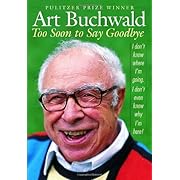
He didn’t go. What’s more, he lived long enough to write a book – Too Soon to Say Goodbye. Those entering a hospice do not usually last longer than two or three weeks. But Art Buchwald stayed on, and on, for so many weeks that he came to be known around the Washington hospice as The Man Who Wouldn’t Die. He left the place in July last to spend summer at Martha’s Vineyard..

Buchwald had his reasons for quitting the hospice. "It didn't work out the way I had expected," he said, "besides, I've gotten so well that Medicare won't pay for me any more". I had my suspicion as to why Buchwald went to the hospice in the first place. So that he could do a book on his near-death experience. Hospices don't usually get written about, because they are associated with death. Buchwald says he spent time at the hospice discussing his funeral with family - details such as where to hold it, how elaborate it should be; and who would speak on the occasion. The columnist reportedly convinced his long-time friend Carly Simon to sing at his funeral.

Another reason, befitting Buchwald's 'unmatched sense of the absurd', could have been the proximity of the hospice to McDonalds, from where he had a steady supply of burger 'n' fries. Besides junk food, said daughter Jennifer, her dad's other enduring loves were, being at the center-stage, spending time with friends, and writing. Buchwald's decision to discontinue dialysis, after he had it a dozen times, put him right there at the center-stage, turning him into a story.

As for spending time with friends Buchwald had so many visitors during his stay at the hospice that on some days it was standing room only. He was believed to have toyed with the idea of putting a tariff on it, $ 25 a visit. His only worry at leaving the hospice, they said, was whether people would still want to see him when he was no longer in the 'death-house'.

Art Buchwald’s only regret, presumably, was that death claimed him before he got around to complete his ultimate work - a pornographic one. In a foreword to one of his books Art Buchwald had observed, "It is absolutely essential that anyone today who claims to be a writer must produce a pornographic book". It was, he reckoned, a status symbol, comparable with that of the Hemingway era, when, in order to be a writer, you had to bag a lion.

"If I ever hope to be taken seriously as a writer, I must get down to work on my book" So he wrote in 1968. But then Art Buchwald could not proceeded beyond the first paragraph. His problem was , "every time I start a paragraph: - ‘Harry looked at the two girls in his bed and shook his head. How could he ever satisfy both of them and still make the seven ten for Scarsdale’ - I say to myself, Is this something the Supreme Court would want to read?"

Wednesday, January 17, 2007

A blog-to-flook story

The Hollywood movie, The Devil Wears Prada, that won for Meryl Streep a Golden Globe Award (2007, for best actress) started life as a blog by Lauren Weisberger. She had blogged about her days as an assistant to Vogue editor Anna Wintour. It made such sensational reading that a publisher chose to make a book of it. The book became a best-seller and morphed into a movie. Ms. Weisberger has since written another book, described by Kimberly Llewellyn as a novel about the glammed-out New York city life entitled Everyone Worth Knowing. Kimberly, a four-book novelist, blogging on Lauren says, "I'd never seen anything like it. The I-Love-Lauren websites. The I-hate-Lauren sites. Incredible. I don't recall a time when a writer has evoked such emotion in readers."

Lauren Weisberger's case may be exceptional, but it does make the point that every other blogger may have a book in him/her. The genre is called 'blook'. But the urge to make a blook of their blogs remains for ever bottled up within most bloggers. Mercifully so, one might add. For, in this age of e-book and self-publishing, if the blooker genie were to get out of every blogger's bottle, there would be a literary tsunami in the publishing scene. It is guesstimated that there are some 50 million blogs out there in blogosphere, and 75,000 more created every day. It is an ego trip for a whole lot of them, blogging. Someone called it e-casting ('e' for ego).

A blook, if you haven't heard, is a hybrid literary form. It is a book that started life as a blog. This new literary genre holds out enticing possibilities. Bloggers, particularly failed authors, need not look for a publisher; nor worry about rejection slips. The age of self-publishing is with us. And the blook is here to stay. The founder of a self-publishing site, Bob Young, has even instituted the Lulu Blooker Award, on the lines of the reputed Man Booker Prize. The inaugural year blooker prize, announced in April last year, attracted 89 entries from 12 countries.

And the winner was blogger Julie Powell, 33, till then an unpuiblished author holding a dead-end office job in New York. She told The Guardian that blogging had kick-started her writing career. And she had no idea what a blog was until her husband initiated her into it. The jury described her blook, "a heartfelt, funny and occasionally obscene tell-all about her journey of self-discovery and cholesterol."

It all started when Julie Powell, frustrated with publishers' rejection slips, and bored with her day job, sought to engage herself by trying out all 524 recipes given in a book of French cookery. Her understanding husband not only tasted what she dished out but also suggested that Julie chronicle her cookery efforts in an online journal. The blog attracted a publisher's attention, and the rest, as they say, is history. Julie's blook is reported to have sold 100,000 copies. Among short-listed entries was by another foodie, Russell Davies who blook-ed a blog on his visits to London's 'greasy spoon' cafes. Title of the blook: Egg, Bacon, Chips and Beans.

The cookery blook-ing reminds me of a friend, Vidya Nagaraj, who has blogged about her online search to get the right recipe for 'masale-puri', a Mysore street-food specialty. Vidya lives in a small Japanese town where her family of four are the only Indians. Her perseverance to take on a Japanese town with her culinary might, her masale-puri recipe hunt, the response of Mysoreans to uphold the culinary reputation of Vidya, nay, of India, in remote Japan, and the hassles of being a vegetarian in a town of non-veggies has in them the spark of a blook.

As she put it in her blog, A Mysorean's Japan Diary, "Vegetable choices are very limited in this small town. For the first time in my life, I saw beans and ladies-finger sold in packets of 6 and 10... Now what is a south Indian vegetarian supposed to do with just 8 or 10 beans?"

Aviator Capt. Anup Murthy was minding his own business (of doing consultancy work and flying airplanes) till he took to blogging some months back. A few weeks into his incarnation as blogger Anup realized he was developing an audience beyond his family and friends. His blog now has a cult following and Anup's air travelogue has given rise to a plea that he publish his blog journal in Kannada.

A Mysore cardiologist, Dr Javeed Nayeem, who has taken to blogging writes about Tabebuia blossoming in his town as knowledgeably as charting a network of heritage walks through Mysore, a town steeped in history. And then we have in Mysore a potential blooker in Mr. Krishna Vattam, an old-time journalist, who recently underwent a crash course in the use of computer conducted by his school-going grandson, so that he could get into blogging to "kick-start his literary writing career". Mr. Vattam's recollection of anecdotal stories on life and past times of Mysore and his propensity to view current events in the context of Mysore's recent history could make engaging blog material. And a potential blook.

The blog-to-movie progression of The Devil Wears Prada makes another point. That there is something beyond blook, for a hit blog - a 'flook'. A flick made out of blook.

Friday, January 12, 2007

CEO Arun Sarin's a 'dignity' clause in his contract


I read ( can't recall where) sometime back, that Vodafone CEO Arun Sarin had it written into his contract that if and when his time came, he could not be asked to go by sending him an unceremonious "electronic mail or any other electronic messaging service." I read this in the context of a report that a UK-based insurance company had sacked 2,400 of its employees via terse e-mail.

By insisting that hiring and firing be done with some dignity, Mr. Sarin can be said to have set a precedent for HRDs. But then, do many of those who get fired really care? The shock could be the same whether you learn of it through a decently drafted e-mail or a three-word SMS, saying 'u r out'.

I once got sacked, but it happened decades before our graceless Internet era. I was then a proof-reader at a London printers. You got paid weekly, on Friday afternoons. And got sacked as well on Fridays. An hour before clock-out on Fridays, the cashier used to go round the printing works carrying a tray of sealed envelopes, and handing out pay packets to shop-floor employees. Like others, I awaited the cashier's arrival with the usual eagerness on that fateful Friday afternoon. He came, delivered, and left. He had left in my packet more money, twice my weekly pay.

Could it have been an accounting error? When I went to him, the cashier assured me there had been no mistake and that all the money was mine for keeps. He also let it be known that the company no longer needed my services. That extra cash was in lieu of the one-week notice period. Can you think of a nastier way of getting sacked? Gracelessness was the standard operating procedure for some companies.

There were exceptions. In Life magazine, it was said they didn't believe in sacking their staff. Instead, the chosen ones were made to feel so unwanted that they left on their own, sooner than later. Writing about her experiences in a book, Such Is Life, a former staffer described how those who fell out of favour were put through, what the author termed, the 'Treatment' by the Life management. A senior writer under 'Treatment' found, on his return from a vacation, that his desk on the editorial floor occupied by someone else. He found his personal effects shifted, in his absence, to an office on the floor above.

At his new office the staff writer was given a room to himself, with larger carpet space. However he was no longer asked to attend editorial conferences. No assignment came his way. He was left to his own devices. The management believed their dignified indifference would drive most people to resignation. But they misjudged the staff writer who used his time in the 'cooler' to write a novel. It got rave reviews. When the management realised he was building up a successful writing career at Life's expense, the man was relocated to his earlier desk on the editorial floor.

Such was Life then.
Now we need the 'dignity' clause.
(Unabridged version at Dateline Mysore, zine5.com)

Wednesday, January 10, 2007

Being positive under provocation

This New Year I resolved to stay unruffled about nasty things people might say. "Don't be provoked, think positive," I said to myself. I soon realised that this was easier resolved than done.

Let me explain. In response to something I wrote, I got a mail, saying, "What the f--- r u",without as much as a question mark by way of punctuation. I didn't mind the f-word, a graphic speech form some people adopt to drive home their point. But his use of 'u' and 'r' was inexcusable. I sent a reply, saying I wish my anonymous friend showed a semblance of e-mail etiquette the next time he sent an abusive mail.

Now, how does one give a positive spin to such mail? Columnist Art Buchwald, they say, hung on his office wall framed copies of selected mail he received. Nastier ones merited the pride of wall space. Some stinkers on display at his office read:
"You are a nasty, ugly old man."
"Get the hell out of the US. Try Siberia."
"We girls think you most contemptible."

"Are you a writer or an idiot?"

Art's point is that you cannot be said to have arrived till you begin getting hate mail. I only wish my anonymous ill-wisher had spelt out his 'u' and 'r' and abbreviated the f-word.

Speaking of English, the language spoken by today's youth doesn't quite conform to grammar and the ground rules of English usage as laid down in Wren & Martin. During my last US trip to visit our son and daughter-in-law, some of their friends addressed my wife and me as "Hi, guys," without making a gender distinction. My wife, who is forgiving by nature, didn't think much of this. I, being a stickler for form, found this 'Hi, guy' thing disagreeable.

Typical snatches of conversation we had to cope with ran like this:
What's up, guys!
You smile, not quite knowing what to say to this 25-year-old who asked the question.
So, what did you, guys, see in LA ?
You list places - Universal Studios, Hollywood Walk of Fame, the Museum of Tolerance and so on.
"What, you guys were in LA and came away without seeing Disneyland?"

I got so worked up over this 'guy' talk by 'desi' friends that I posted a message on an NRI web site, giving vent to my smouldering indignation. My message evoked an e-mail response: "Tumhe aur kaam nahin hai kya? Are you unemployed, or something?"

This was deflating. This happened a while before my New Year resolve . Now, with my new-found positive mindset, I reckon, I shouldn’t have dripped over this 'Hi, guy' thing, in the first place. I can see this as a generation leveller. Viewed in this light I would rather have a young thing address me, 'Hi, guy,' than 'Uncleji.'

Recycled from Dateline Mysore, zine5.com

Saturday, January 06, 2007

Would anyone know God's e-mail ID ?

If marriages are indeed made in heaven, it is time God looked into the affairs of His department of matrimony. It has given too much licence to too many to enter into matrimony on the flimsiest of grounds - love. Whoever says a marriage works merely because the boy and girl involved are emotionally involved. We see the same old tiresome story being played out everywhere. The boy and the girl fall in love, become man and wife, fall out of love and live miserably ever after. Or have their personal lives exposed in divorce proceedings.

I want to send God a memo on the marriages He makes in heaven. Would someone let me have His e-mail ID? "I'm not even sure I believe in marriages anymore," said Gloria Swanson, a movie star of the silent era, after three unsuccessful marriages. I have just finished reading her engrossing memoirs, Swanson on Swanson. It is a 550-pager and Gloria needed every page to recount her life story spanning five marriages.

Murphy's law of wedding states that everything that can go wrong with a marriage usually does. I read somewhere that 45 percent marriages in the US end up in divorce. Can God afford such high rejection rate of marriages made in heaven? In India we have other ways of putting an end to marriages. Such as bride burning. This happens in 'wed-now-pay-later' cases. Trouble arises when the bride's parents don't pay dowry. You see, marriages, even if made in heaven, can be about money.

The Heavens have been much too liberal in sanctioning so-called 'love marriages'. If you ask me, it is a contradiction in terms, love marriage. For love, as we knew it during courtship, rarely survives marriage. People in love have no idea of what they are getting into. Nor are they in a mood to listen to voice of experience What they don't realise is that unlike courtship during which lovers spend quality time together, marriage means spending time with your partner on a 24-hour basis.

When love fades out and you come down from cloud 9 you might well be lumbered with a spouse who snores, blabbers in sleep, watches too much sports on TV, takes too much time at the bath and carries magazines to the loo. It is adjustment, accommodation, understanding, a flair for argument usually over trivia and a spirit of endurance that sustain a marriage.

I have nothing against love marriage. My son Ravi has married the girl of his choice. To be candid, I can't say I jumped with joy when Ravi first mentioned Meera, the girl he had in mind, in a long-distance call from the US, I was relieved, though, to learn that the person my son had in mind for matrimony was not Mexican, Spanish or Chinese, but an ABCD (America Born Confused 'Desi'). Meera must have been a confused girl. How else could one explain her choice? Normally, I am not among those who would quarrel with the notion that love knows no nationality. But this case wasn't normal. I was the father of the groom.

As father of the groom, I had certain responsiblities, such as breaking the news to my aged parents, their conservative clan of relations at Pollachi, not to speak of my wife's not-so-progressive sisters. My son choosing his own life-partner was, in itself, enough to raise their conservative eye-brows. And a girl born and brought up in the US was clearly an unknown entity. No one in our family circles was familiar with such species.

Meera helped matters by making a pre-wedding familiarisation visit to India. She spared me the unenviable task of having to reassure our relations that not all America-born girls need be 'memsab' in temperament. With her unassuming ways and pleasing manners Meera managed to dispel apprehensions and inspire confidence and affection in my clan. The only snag was that many of my relations couldn't get the hang of Meera's accent.

Parental concerns are not always in the reckoning of some of our determined youths. Defiance of parents by those in love is a running theme of many of our movies.If God wants to protect his made-in-heaven brand image, he ought to rein in love-struck youths from rushing in where sensible people would pause to contemplate the consequences of matrimony. Today's youth watch too much soap, too many movies such as Dil to Pagal Hai, Kuch Kuch Hotha Hai, Salam Namaste, and, of course, that mother of all mismatched couple movies - Kabhi Alvida Na Kehana.

If such films have to be made at all because of box-office compulsions, they should be given 'PG' certificate i.e. vulnerable youths could be allowed to watch such films only in the company of sensible parents.It is a matter of perspective. Take Devdas. I view it as a promotional film for liquor; and also a film about the virtues of arranged marriage. Paru's parents in Devdas ensure that their daughter has an enduring married life. Just imagine her plight, if Paru had married Devdas.

Tailpiece: The last time I sent a communication to God was in 1971. The letter (no Internet then) I sent was returned undelivered. I had not given the proper PIN code for heaven. 1971 was the year I got married.

For the unabridged version of this piece look up Dateline Mysore in zine5.

Tuesday, January 02, 2007

Saraswati, an Unschooled Middle-class Mother

(Republished to mark the death anniversary of a woman of substance. The piece was initially published in Jan.2003)

My neighbor in Coonoor, G.V. Raman, lost his mother, Saraswati, when she was nearly 90; an age when she believed it was better to be gone than be alive any longer, overstaying your welcome. A month before her death she had made out a will, listing among other items a bank deposit of Rs. 50,000 to be set aside for funeral rites. She also made a trip to Coonoor that was to be her farewell visit.For someone named after the goddess of learning, Saraswati didn't do much schooling - a third standard dropout. Saraswati belonged to the vanishing species of unschooled middle-class mothers. They don't make mothers like Saraswati nowadays.

Today's middle-class mothers come with an academic degree. Which doesn't necessarily make them more educated. The purpose of education, one would think, is to enable you to cope with the world you come to confront in life. Saraswati's world centred around her husband and children and she learnt to cope with the rigors of domestic life at an age when today's girls are at school and full of dreams fed on Barbara Cartland. Saraswati became a near child-bride, kept house and bore children before she turned 20. She was married at 13 to someone eight years older than her. On the final count she produced 11 children - eight male and three female - of whom seven (four and three) survive her. No school or university can offer a course to cope with this situation.

If anything, among the Western educated women there is a libbers' school of thought that would like to wish away motherhood. I read about this writer, Ellen Peck, whose book The Baby Trap extolled the virtues and joys of not having children. She composed an obituary to motherhood, which was published in The New York Times on Mother's Day. Saraswati's generation was brought up in a tradition where women didn't have rights. She only had duties. A woman was expected to be a dutiful daughter, dutiful wife and mother. It takes some education in tolerance for one to conform to such tradition.

"My mother was solely devoted to the comforts and well-being of my father," says Raman. Always at her husband's beck and call, Saraswati's purpose in life was to please him.Her husband's position at the Aruvankadu cordite factory in the pre-Independence days entailed occasional entertaining of his British colleagues at home. Saraswati picked up enough social etiquette to make inane small talk with Mrs Norris, Flannegan or McCantyre.

At Pune, where her husband was posted , Saraswati had the occasion to accompany her husband to a VIP reception at which the visiting governor sought her out to exchange a few words. Saraswati was the only woman wearing diamond nose-rings and sari in the 'madisar' style adopted by orthodox Brahmins. "Mother didn't betray any communication problem," says Raman. That she didn't know a word of English didn't pose difficulty. She had mastered Ananda Bodhini, a guidebook that listed core English words and their meaning in readable Tamil.

She wouldn't address her husband by name, not only out of reverence but also because of a belief that a woman who addressed her husband by his proper or nick name tended to shorten his life. He died some 25 years earlier than she did, even though Saraswati was scrupulous enough not to address him as Gopalan even once in his presence. According to Raman, his mother's only regret was that her husband did not live to share with her the fruits of his government service. His last drawn pension was less than Rs. 500 while Saraswati drew a family pension that was ten times the amount.

And she spent much of it on gifts, tips, autorickshaw rides to the bank and, occasionally, movies. Rajnikant was her favorite. She listed in a diary all the films she had seen her entire life. Raman described his mother as sociable. She relished spending evenings at the sit-out in front of her house watching the world pass by and trading gossip with the milkman, vegetable vendor and the flower woman who relied on her for their daily news fix. The old lady's favorite reading was Dina Thanti , a Tamil daily noted for its coverage of crime and social gossip .

Saraswati was fastidious. Till death she wouldn't give up on the nine-yard sari, wearing which was increasingly becoming an ordeal. She never sat down to eat without a napkin; and always rounded off her meals with sugared curd in a silver cup and spoon.As Raman put it, "My mother might not have been born with a silver spoon, but she left behind one." He treasures it

Saturday, December 30, 2006

FAQ: What do I do the whole day?

I remember an envious colleague telling me on the day I retired, "I wish I too could say, a Monday is just another day."

Ogden Nash articulated the thought in a verse:
Monday is the day that everything starts all over again;
It's the day when life becomes grotesque again,
Because it is the day when you have to face your desk again;

The bliss of retirement, of not having to go to work, is short-lived. Before long you discover there is another side to a life free from Monday-morning work hassle. Now I have people asking how I manage to spend time in retirement. I tell them about my collection of unread books, the TV remote, that handy device for channel-surfing. I tell them about my blog. They nod agreeably. And just about when I feel that the issue has been settled, they pop the question: "Yes, but what is it that you do the entire day?"

Even while in service, friends and relatives, whose perception of a journalist is based on what they see in movies, had difficulty believing that I was capable of an honest day's work. A journalist is seen generally fooling around in coffeehouses or the press club much of the day, dropping in at the office for a while to work the phone and tap a few hundred words on his PC before rushing out for cocktails in the evening. If this is called work, they wonder what idling would be all about.

I mean, they can clearly see the slogging involved in the job done by a ledger-pushing bank clerk or a bricklayer. Even some government babus manage to look busy and purposeful. But when it comes to the media, people are a bit dense on what, precisely, a newspaper correspondent does. I suppose one could raise the same question about the Pope or the President of India.

Our TV and print media photos usually show the President taking a leisurely ride on the horse-drawn Victoria down Rajpath on R Day, hosting lavish parties for visiting dignitaries or pinning medals on people. My boss at the Times of India News Service desk was seen doing not much other than signing sub-editors’ duty charts, leave-sanction forms and lighting up his Guntur cheroot that got put out every now and then. He made seem time-consuming. The boss always managed to look important, purposeful, and in his loosened up tie and rolled up sleeves, fully occupied.

As I said, since retirement the most persistent FAQ I have had, even from well-meaning folk: What do I do the whole day? Spending time on the Net, or with a book, isn’t seen as ‘activity’. I don’t go to the bank or post-office; or stir out my house to pay the phone or power bill. I had a neighbour in Coonoor who had a flair for fixing things - electric iron boxes, mixie, torches, vintage HMV sets that play gramophone records and virtually any other thing that would otherwise have been consigned to the kabariwalah.

Watches and wall clocks that don't run fascinated my busybody neighbour . Occasionally, when he found himself on loose ends, he checked out his neighbours, asking if they needed anything he could fetch from the market or if they had a dripping tap that needed a fresh washer. In contrast, there I was, doing none of this. Must confess I haven’t even mastered the art of wiring a blown fuse. What’s worse, I often get caught ‘book-handed’.

If there is anything a wife usually gets bugged about in a man milling around the house 24x7, it is his obsession with books. Her refrain, ‘don't sit there hiding your face behind a book, do something.’ In retirement, count yourself lucky if you get to read a book, without being interrupted, by having to answer phone calls that are usually for others in the house; distracted by someone ringing the door bell – dobhi or subzi-lady. This is when you miss the office. I used to take a book to work; averaged two titles a week.

Retirement is not all about a running argument with your wife. It makes you more reflective; ponder philosophical questions such as, "How did I age so quickly?" It seemed not so long ago, when I was a care-free bachelor, then, a not-so-caring husband in newspaper, and job-driven absentee father for my son; and now, a grandpa. After retirement, notably, after a grandson happens, you find more relevance to life. Snag is you realize that there isn't much life ahead for you to benefit from the enlightment.

And then the changed lifestyle leaves you with time to think, particularly during those insomnic spells. Few people really do think, although most believe they do. Thinking is demanding and tiring. It is an exercise for the mind. Thinking is hard work. Need I say anything else about how I spend most of my day?

(See earlier version of this piece in zine5.com)

Wednesday, December 27, 2006

Of Punch & Shadow, and a street dog named Brownie

When our Bitsy died my wife and I resolved never to keep a dog ever again. Bitsy was irreplaceable. But my wife's madness for dogs hasn't gone away, even decades after Bitsy's death. It is in her DNA. Whenever she phones any of her many sisters the conversation eventually turns to dogs. She talks about Prince with Gowri in Mysore; about Joey, with Chitra, the dead old Tuffy, with Rajesh (both in Chennai). At a recent family get-together in Bangalore, hosted by Gita, the bunch of sisters ran a seminar on dogs. Besides their own Punch and Shadow Gita's daughter, Bubly, is friends with Rocky, Tommy, Blackie and a couple of other street dogs of Kammanhalli, Bangalore.

Speaking of street dogs we had one at Coonoor that fed on leftovers offered by neighbourhood residents. Piloo Nazir, who isn't a rice eater, bought rice from the fair-price shop, only to feed our friendly neighbourhood dog. She boiled leafy vegetable with a fistful of rice, and served it without salt or sugar,but with spoonsful of sympathy. The dog had it all without complaining.

But then he was not finicky, like Prince in Mysore, who would wait till late in the evening, on an empty stomach, for his master Raghottam to come home from the club with the customary packet of chicken bones. Our neighbourhood dog was not as fussy as Shadow in Bangalore who would want his fresh milk and rice served in stainless steel bowl, preferably hand-fed by my niece Bubly. Our dog was not as pampered as Tuffy or sheltered in a Velacherry delux apartment as Joey.

When my nephew Kartik had to leave Joey in the care of the SPCA at Vepery, Chennai, for a few days, the handler was instructed to serve him curd and rice, which wasn't on the kennel menu. The dog handler told him that he would have to order it from a nearby restaurant. Kartik left with him a hefty advance to cover the food plus a little something for the curd-and-rice care.

Yes, we are a dog-mad clan. I must say I married into one. Before our wedding, my wife had a dog named Bhutto. Whether or not Bhutto is remembered in Pakistan, the name is part of our family folklore. I am not sure what prompted my wife's family to name their dog after a signatory to the Simla Agreement. But then there need not always be a reason for in one's doings.

Unlike pet dogs that are taken out for daily walk by pet owners, our dog in Coonoor used to walk people in the neighbourhood. He escorted school kids to the bus stand. He took our neighbours, the Ramans, to the temple, and escorted my wife and me on our morning walks. Which was why we named him Walker - Brownie V Walker, to call him by his full name. That 'V' in the middle sorted him out from other Brownies in town. One should not confuse our dog with Brownie A Walker ( of Aruvankadu) or 'B' (for Bedford) Walker. I don't know why, but most street dogs we found in Coonoor were brown.

Walker had many friends, who joined him on our walks. And before we made it to the St.Anthony School kerb, we had a gang of brownies, all friends of Walker, walking us along. At times Walker followed a jogger for a few yards to sniff him out. A few of the morning walkers he didn't particularly fancy. There is this lady with a boy's hairdo. Whenever she happened to overtake us on the street, Walker barked. She was not amused; we looked elsewhere in embarrassment. The lady once shouted out across the street, asking us why we didn't have him on a leash. She, probably, didn't see Walker was a street dog who happened to walk along with us.

We could not get rid of him, even if we wanted to. There is no way Walker would disown us. He has no ego. Shoo him away and he would be back, wagging his tail with added vigour before you could say Brownie Vannarpet Walker. At times I got put off by his prancing, pouncing and licking at my forearm as soon as I step out of the house in the morning. Walker, who spent the night out in the cold, was always at our door-step in the morning. We humans we are so full of ourselves that we fail to to appreciate Walker's selfless cheerfulness after a night out in the cold and the exuberance with which he greeted us in the morning.

But then I couldn't bring myself to admit Walker into the family fold. You see, we once had a dog, Bitsy, who was picked up from the streets in Bhopal. We took Bitsy along when I was transferred to Chandigarh and then on to Chennai. He died at the age of 13, of kidney failure. Bitsy was an adorable rogue and undisciplined to the core. The only person he ever listened to was Dinkar, our office assistant. But then Dinkar could not come with us to Chennai. Fortunately, we had a spare bedroom in our Pantheon Road residence and we locked Bitsy in there whenever we had visitors.

Those who know dogs know that most of them are allergic to khaki. Walker didn't fancy our postman. We could have asked him not to wear khaki, if only to appease Walker. But that would have been against regulations. But then Walker was freaky. He didn't like my newspaper delivery boy either. And he didn't wear khaki.

We really don't understand dogs, do we? My junk mail the other day had this to say about dogs:
They follow you around with their tongues out; only respond to simple commands; their needs are basic and predictable; they whine when such needs are not met; they scratch a lot, and sometimes drool; make loud noises and sometimes smell bad; they are rude and rowdy, especially when they are with others like them.

What does it all add up to? Dogs are men that wag their tails. In some respects, they are more sensible than humans. I have not seen a dog throwing stones at stray men. Have you ?

Monday, October 02, 2006

Talking Gandhi over brandy

(Published in Nov. 2003, the theme of this piece is ever-relevant, and eminently recycleable every other Oct. 2. Wonder if Dr M S Rao has found a publisher for his irreverent book on Gandhi.)

It takes courage for someone to attempt a book on Gandhi. He is so over-written about that a Google web search for books on the Mahatma throws up 324,000 references. There is so much information overload that anyone who entertains thoughts of publishing yet another book ought to be either Gandhi's grandson or mentally challenged. Dr. M.S. Rao is neither. And he has a book in the works; and is in search of a publisher.

Dr. Rao, a medical practitioner disenchanted with his profession, is settled in Coonoor and runs a guest-house - www.trystindia.com - with his English wife. Apparently, he has better credentials to write about the ills of medical profession than about Gandhi. Dr. Rao has written about it in 'Look After Yourself. No One Else Will - How to bypass the medical profession and stay healthy'.

I didn't know Dr. Rao well enough to dissuade him from doing the Gandhi book when he called me the other day for a get-together. I didn't know what I was in for when I suggested the Velan Ritz bar. Discussing Gandhi over rum and lukewarm water wasn't quite my idea of spending the evening. Besides, care-takers of his legacy would rather prescribe a glass of goat milk to go with Gandhi. Speaking of legacy, it is said a London restaurant owner named his enterprise Gandhi Steak House. In a magazine article Gopalkrishna Gandhi said, 'Gandhi (the name) sells, so does his steak; and together the two work magic for the restaurant owner'. Speaking for himself, Gandhi's grandson says it works for him eminently - 'paths open, pot holes close to let the person bearing the name pass'. At airports he gets waved through by customs officials when they look at Mr Gandhi's passport.

Dr. Rao is no goat-milk Gandhian. Indeed he believes that Gandhi needs to be saved from such elements. He claims his book is an attempt to 'liberate' Gandhi. The thing that is going for him is this incurable obsession with the subject and Dr. Rao's belief that no book has succeeded in explaining fully the phenomenon of Gandhi, who, he says, is impossible to pigeonhole. As he put it, the man was a politician, philosopher, doctor, dietician, sex-therapist, ascetic, veterinarian, social reformer, woolly-headed anarchist, mystic, rabble-rouser and a compulsive cleaner of latrines.It is about time someone presented Gandhi in a manner that was not only acceptable to the present times, but interesting to an entire spectrum of readers, says Dr. Rao in a prologue to his book, which is nearly done. The prologue gives us the author's sense of Gandhi in today's world.

Dr. Rao poses the question: What, for instance, would Gandhi do, if a bunch of thugs rough him up, as they do in Mafia movies? After the deed is done the thugs leave Gandhi, with a bleeding nose, and a warning: "It will be worse next time, old man, unless you give up making salt."And then Gandhi gets a call from another thug informing that one of his sons was being held for ransom and he would be killed, if Gandhi didn't pay up. To which Gandhi reacts, "You've got the wrong number, mate. I have no dough, so go ahead and do what you think is best. By the way, which son of mine are you holding? I have millions of them." So spoke the father of the nation, in an alien accent. Having spent 17 years in Liverpool Dr. Rao can't be faulted for embellishing Gandhi's lingo.

Dr. Rao says one can find much that is self-incriminating in Gandhi's own writings. And anyone diligent enough to go through them could interpret Gandhi in any light. If one wanted to dismiss Gandhi as manic depressive, one could do so in Gandhi's own words. "If we were to conclude he was an egotist, he says so himself; a sexual faddist, he tells us this quite plainly; and a nut case, he joyfully agrees," says Dr. Rao.The author says he has peppered his book with remarks on Gandhi by non-Indians, because "citations from others are, by far, the surest way to impress Indians, whose peculiar psyche does not lend them to believe their own kind." A book gets noticed, if it informs, interprets, irritates or exhilarates the reader. Whether or not he delivers on the other three attributes it appears Dr. Rao would have no problem irritating readers with some of his self-opinionated remarks.

Tuesday, September 19, 2006

A social nobody, with no-good address

(Published in Sept.2002 when I used to live in Coonoor. Now based in Mysore, I stay on the classy end of Dewan’s Road, where real-estate value of flats has nearly doubled in the last two years, says my friend and property developer Mr M B Nagakumar.)

At out-of-town parties and social gatherings when people learn I belong to Coonoor, I tend to draw more attention than other out-of-town guests, say, from Cuddalore or Namakkal. "Oh, you're from Coonoor?" they ask with envious interest, taking you, perhaps, for a planter, a retired company vice-president or Maneckshaw's neighbour. The moment they learn that I live in Vannarpet, Coonoor, the "interested" guests lose interest and move along to find someone else to say "hi" to.

Some socially self-conscious folk in my locality feel that I misrepresent our address. Balaji, a youth in our neighbourhood, can't see why I keep mentioning Vannarpet, while our housing board flats are located at Srinagar Colony. I tell him that even the beat postman and auto-men are not quite familiar with this name. In fact, our locality has yet another name - Thanthai Periyar Nagar. I whip out my voter identity card to prove this.

Balaji has a point. By flaunting my unenviable address I might be making a social statement.Vannarpet, I concede, doesn't sound quite classy. The address could prove fatal for social-climbers. You could lose a contact, as I did with an old schoolmate of mine. After we finished schooling in New Delhi in the late fifties, we went our different ways, till our paths crossed three years back. That was when I heard that my schoolmate had become the top brass in the Coonoor military establishment. His address: Flagstaff House, Wellington.

I phoned and he was happy to hear from an old schoolmate. A few days later he asked my wife and me to dinner at the Flagstaff House. We spent a pleasant evening, at the end of which we resolved that we would stay in touch. But we never got round to meeting again and my friend eventually retired from the army and left Coonoor. I can't figure out why we didn't meet again, but the thought crossed my mind that my address might have had something to do with it. But to be fair to him, I must say we had not been pals at school, though we have had some common friends.

In my younger days when I spent three years in London my friends and I were particular about finding digs at a "decent address." We would not have anything to do with Southall, which had the reputation of being blue-collar and infested with our compatriots. A joke that did the rounds had it that when someone asked a policeman for directions in Southall, he was told, "Turn right at the traffic lights, take the third left and follow the curry-smell and you can't miss it, mate." The stranger followed the directions faithfully, but got confused by a profusion of curry-smells. The friendly London bobby had not said which curry - mutton, fish or plain chicken.

Those days you could get a reasonably big and fully furnished room, all to yourself, for three guineas a week in Brixton, Camden Town or Shepherds Bush. But we were willing to pay as much and a few bob more for an attic or even basement digs, so long as it carried an address in Chelsea, South Kensington or Hampstead.

The London telephone numbers in the sixties carried a three-letter area code followed by a four-digit number. I used to share a bed-sitter with a friend at Bayswater, a middle-class locality, but we managed to get an 'MAR' phone number that belonged to the Marble Arch exchange, an upscale commercial district. My crummy basement room at Swiss Cottage had a phone connected to the exchange at Hampstead, an affluent residential area. It helped to have a classy area-code, particularly if you needed to work the phone in your line of business. Area codes such as 'HAM' (for Hampstead), 'BEL' (Belgravia) or 'KEN' (Kensington) had an element of social magic that persuaded unsuspecting strangers to return your calls.

Of course, you can't underrate the importance of acquiring a London Westend address. It made business sense for commercial establishments based in the suburbs to rent a Westend postal address. I worked for a few months in a shoestring community news weekly, India Weekly. that was brought out by a voluntary group of journalists. But we had an impressive address that we shared with the London Bureau of the Ananda Bazar group of newspapers. India Weekly was located next door to the London Daily Mail on Carmelite Street. I could claim that I have worked in the famed Fleet Street.

Subsequently, I edited The Afro-Asian Echo, a journal run by a Nigerian who had fled to London with his loot in the wake of the civil war in his country. He paid through the nose for locating the Echo's business office in the upscale Oxford Street area. And the journal folded up in six months. Maintaining a classy business address proved fatally expensive. The Nigerian still owes me a month's pay.

In the US the very well-to-do live in gated communities where you can't acquire real estate merely because you have the lolly. You've got to be socially acceptable. This rules out most ethnic minorities and African-Americans unless, of course, you happen to be Oprah Winfrey or Denzel Washington. Social exclusivity is zealously guarded by residents. Their point is acquisition of houses by any Tom, Dick or Harry who can pay the asking price tends to bring down the property value in the area.

Nearer home, I can't think of a city better planned for perpetrating social snobbery than New Delhi - the largest babuland in the country. You can judge the status and class of a government official by the locality he comes from. Sarojini Nagar is Class III and II. Kaka Nagar is decidedly Class I. R K Puram and Rabindra Nagar are both government residential colonies, but they are a class apart. Residents of Moti Nagar are not in the same league as those living in Maharani Bagh.

A socially upscale address does not necessarily mean decent living conditions. I spent over 10 years in Chennai in a flat infested with mosquitoes all the year round. Coovum flowed, nay, remained stagnant with syrupy effluent, barely a block away from our apartments complex. Whenever the wind blew our way the stench would waft into our second-floor drawing room. When it rained one had to wade through ankle-deep water to reach the parking lot. The residents shared the apartment complex with lizards, cockroach, bandicoots and an assortment of other janthus. My address: Parsn Towers, Pantheon Road. It was classy

Monday, September 04, 2006

VIPs: Some are, Simply, Simple

(Sonia Lunches with 'Commoner' - Newspaper headline.

Karnataka Chief Minister, Mr H D Kumaraswamy, has taken to overnight halts at villagers' residence while he is out on tour. This way, says CM, I get to understand people's grassroots problem better.
We have a President with the common touch. The very name A P J Kalam has become synonimous with simplicity. Following piece appeared in July 2002; was written on the eve of Dr. Kalam's shift in residence from the residential quarters of Anna University, Chennai, to Rashtrapati Bhavan.)

So, our 'missiles man' Kalam put himself through the security routine at Chennai airport the other day. Kalam Insists On Going Through Security Process said a page four box-item in The Hindu. His 'insistence' on opening up his own hand baggage for inspection is understandable. For A.P.J. Abdul Kalam, after moving to Rashtrapati Bhavan, would no longer be allowed to get away with such a thing. Surely, we can't have our President queuing up at the Indian Airlines check-in counter.

Dr. Kalam being frisked by a CISF chap before walking through a metal-detector would have made a great picture. It could have been turned into a media event. His airport security act might be seen by critics as a PR exercise. But then the MIT (Madras Institute of Technology) diploma-holder in aeronautical engineering who scaled such heights in the world of academics and scientists doesn't have to resort to such stunts. The humility and simplicity of the man is writ large on his face, attire and demeanour. In fact, if Dr. Kalam were to travel abroad without the Presidential 'bandha,' some uninformed 'immigration' bloke at a European airport might pull him in for questioning, as happened to Dr. Amartya Sen at Zurich airport some time back.

At Coonoor, where I live, I have seen Field Marshal Maneckshaw awaiting his turn at the cash counter in a bank. My bank employee neighbour Jayakumar made acquaintance with the Field Marshal during his periodical visits to the Bedford branch of Union Bank. An ex-serviceman himself, Jayakumar is overwhelmed by Maneckshaw's refreshing accessibility - "When I was in the army I couldn't dream of going anywhere near the general, let alone having a word with him."

Dr. Shankar Dayal Sharma, as union communications minister, used to visit the Hanuman temple in New Delhi's Irwin Road on Thursday evenings without 'bandobast.' The message Kalam and Maneckshaw send out through personal example is generally lost on most others in public life, for whom rules and regulations are meant for lesser mortals, and flouting them is the norm for a VIP. Haven't we heard of 'chota-mota' political busybodies throwing their weight about at airports and, at times, holding up commercial flights to await the late arrival of some VIP? Black cats in attendance, escort vehicles and advance patrol cars constitute the ultimate status symbol.

We now have a President who delights in browsing at airport bookstalls and chatting with the sales staff. The question is: would Dr. Kalam be able to, nay, would he be allowed to, do his thing, now that he has tenanted Rashtrapati Bhavan? Presidential office is protocol-driven and an element of pomp and ceremony goes with the turf. Initial reaction to Kalam's choice as the NDA presidential nominee was one of surprise in many quarters. Besides, one doesn't associate the likes of Dr. Kalam with the political polemics the presidential race evoked.

And then, it was not as if he got elected to the highest office in the land on the strength of personal credentials. Dr. Kalam wasn't even the first choice of NDA, which was shopping for an expedient 'minority' candidate. Cynics would have us believe that there was a toss-up between Muslim and 'Isai' in which the former had an edge. The outcome of the presidential race would have been different had Dr. Kalam been adopted by the left parties instead of the NDA.

Viewed in this light, the presidential race smacked of political match-fixing. Everyone knew the score even before the game started. What mattered was the numbers, not the relative merits of the opposing candidates. There is no such thing as 'conscience' vote in political contests. The last time they resorted to the ploy was when Indira Gandhi backed V.V. Giri in the name of 'conscience' vote against the official presidential nominee of the Congress. In politics, you follow your 'conscience' only if you want to split the party.

I admire Capt. Lakshmi Sahgal for her courage in taking on a fight she very well knew she couldn't win. She called it a 'symbolic' contest; willingly submitted herself to becoming the 'symbol' for the side that didn't have the numbers, but wanted to make a political point. The left parties sought to demonstrate their 'ideological' divide with the BJP-led ruling alliance.
NDA, in its choice of Dr. Kalam, sought to play the 'minority' card. We didn't see him as a Muslim till the BJP-driven ruling coalition opted for Dr. Kalam's candidature.

We have had Muslims as Presidents before, but the circumstances were not the same. The Gujarat riots and BJP's party political compulsions in the state accounted for an unwarranted focus on Dr. Kalam's minority status. Likewise, few saw Capt. Sahgal as a Tamilian. That she was a Tamil by birth was made out to be a factor in the contest against the Ramanathapuram-born A.P.J. Kalam. We have had a contest between two illustrious persons who belonged to the same and the smallest of the minority groups - 'Hindustani.'

Back to MyMysore site